Dr. Douglene Jackson on Conscious CARE, Workforce Well-Being, and Why Sustainable Care Begins with the Practitioner
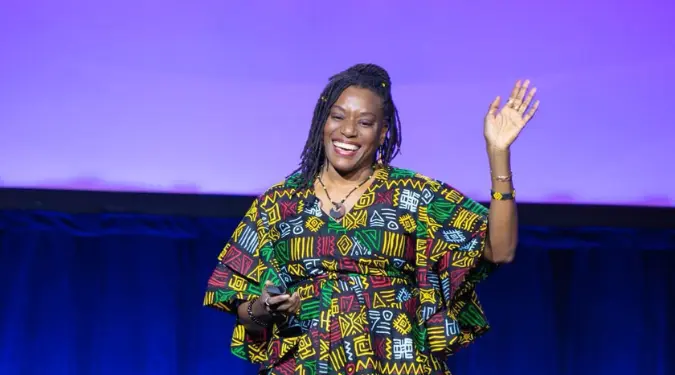
When Douglene Jackson, PhD, OTR/L, LMT, ATP, CYT, FAOTA, delivered the Dr. Lela Llorens Lecture at the AOTA INSPIRE 2026 Annual Conference & Expo in Anaheim, California, the moment carried deep personal and professional meaning.
Dr. Jackson, Doctoral Capstone Coordinator for SCU’s Doctor of Occupational Therapy program in Phoenix, was tasked with delivering the lecture after receiving the 2025 Dr. Lela A. Llorens Award of Excellence for Diversity, Equity, and Inclusion from the American Occupational Therapy Association.
Her presentation, titled “Conscious CARE: For Self, For Society,” introduced her Conscious CARE Framework, a values-based approach centered on compassion, awareness, reflection, and embodiment.
Developed from Jackson’s more than 25 years of experience in occupational therapy practice, education, leadership, advocacy, and workforce development, the framework responds to a growing concern across healthcare and human services: how providers can continue to care for others while also protecting their own capacity to remain grounded, reflective, and well.
In this Q&A, Jackson reflects on the significance of delivering the Dr. Lela Llorens Lecture, the experiences that shaped Conscious CARE, and how the framework connects to occupational therapy, Whole Health, and workforce well-being.
What did it mean to deliver the Dr. Lela Llorens Lecture?
Dr. Douglene Jackson: It was a very proud moment, as I reflected on having read some of Dr. Llorens’ work while an occupational therapy student and meeting her in person at an AOTA conference.
I recalled her saying, “I’ll be watching you,” and she was later instrumental in my joining the American Occupational Therapy Foundation Board.
What was the focus of your presentation at AOTA INSPIRE 2026?
Dr. Douglene Jackson: The presentation focused on the Conscious CARE Framework, which I developed to promote workforce well-being and improved health outcomes. Providers of care seldom take time to prioritize and care for themselves, even though their own well-being is essential to the sustainability of the workforce and the quality of care they provide.
I concluded with a reminder that before we are practitioners, leaders, educators, students, or caregivers, we are first human beings with unique identities and lived experiences. I encouraged attendees to be human by caring for themselves and honoring their own humanity; be humane by extending compassion and dignity to others; and be for humanity by using their gifts and influence to create healthier, more caring communities. I invited participants to make a personal commitment to practicing Conscious CARE in their everyday personal and professional lives, recognizing that workforce well-being begins with how we care for ourselves, one another, and the world around us.
What inspired you to develop the Conscious CARE Framework?
Dr. Douglene Jackson: As both a patient and provider, it became very evident to me that such a framework was needed as a reminder to be conscious of how we show up for others, as well as for ourselves.
This not only means engaging in self-care to avoid burnout, but also considering how we promote principles of diversity, equity, inclusion, justice, accessibility, anti-discrimination, and belonging. These are more than terms and should be integral to how we practice and support our own well-being as practitioners.
What does Conscious CARE stand for?
Dr. Douglene Jackson: The Conscious CARE Framework centers on Compassion, Awareness, Reflection, and Embodiment.
These practices are intended to help practitioners pause, examine their own lived experiences, recognize systemic stressors, reflect on how they show up in practice, and embody values-aligned action.
The core message is simple but powerful: Conscious CARE begins with you.
Why is workforce well-being an urgent issue for healthcare providers?
Dr. Douglene Jackson: Many healthcare providers are experiencing increasing levels of burnout and attrition from their professions, with research also citing suicide in some cases. It is important that we dare to lean into our own well-being because that is what creates workforce sustainability in a system where so many shortages exist.
When practitioners are burned out, morally distressed, or disconnected from their own well-being, it affects not only the individual provider but also the care they deliver and the systems in which they work.
Well-being must be intentionally protected. It cannot be treated as an afterthought.
How does Conscious CARE connect to occupational therapy?
Dr. Douglene Jackson: This work aligns closely with occupational therapy’s holistic view of human beings, participation, context, and occupational justice.
The World Federation of Occupational Therapists recently adopted a new definition of occupational therapy in 2025, and I like to amend it to say, “We help others, and ourselves, engage in meaningful occupations that we want, need, or aspire to do.”
That includes embracing our own well-being through holistic practices and aligned approaches that we also extend to our clients. In that way, Conscious CARE fully embraces the values and purpose of occupational therapy.
How does this framework align with SCU’s Whole Health approach?
Dr. Douglene Jackson: Conscious CARE connects with SCU’s Whole Health approach by emphasizing the integration of mind, body, spirit, environment, community, and systems.
It supports whole-person and whole-practitioner well-being by encouraging practitioners to consider not only the well-being of the people they serve, but also how they care for themselves within the systems where they work, live, and play.
For practitioners who feel exhausted or disconnected from their own well-being, what is one first step they can take?
Dr. Douglene Jackson: The first step is tuning into ourselves, engaging in interoceptive and reflective practices to assess our personal states, and taking intentional actions to support our well-being.
As I shared, Conscious CARE begins with you.
What did you hope attendees would take away from your presentation?
Dr. Douglene Jackson: My aim was to broaden everyone’s toolkit by allowing for practical and experiential components, including meditation, reflection, and establishing a personal commitment to their own well-being.
I hoped attendees would leave with three key takeaways:
- First, well-being must be intentionally protected, not treated as an afterthought.
- Second, practitioners must examine how compassion, awareness, reflection, and embodiment shape ethical and equitable care.
- Third, workforce well-being is directly connected to client outcomes, organizational culture, and the future of occupational therapy.
At its heart, Conscious CARE is about helping practitioners recognize that caring for themselves is not separate from caring for others. It is part of sustaining meaningful, ethical, and human-centered practice.
Related Posts