What It Takes to Build a Whole Health University: Lessons from Creating the Framework
By John Scaringe, DC, EdD, President & CEO of SCU
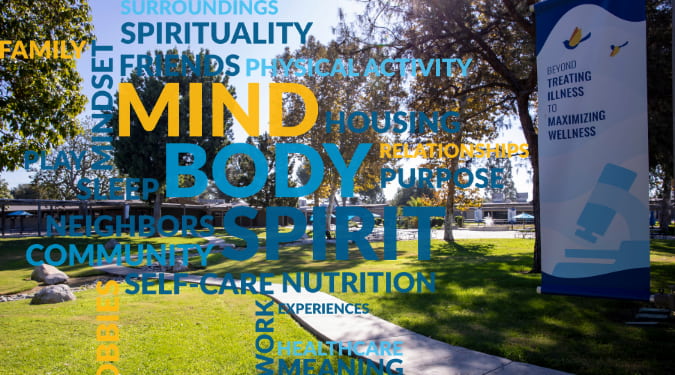
Whole Health has traditionally been discussed as a model of patient care. Whether in integrative medicine, primary care, or the U.S. Department of Veterans Affairs, Whole Health approaches are designed to help individuals achieve better health outcomes by addressing the interconnected dimensions of physical, emotional, social, and environmental well-being.
At Southern California University of Health Sciences (SCU), we began asking a different and more expansive question:
What would happen if the principles of Whole Health were applied not only to individuals, but to an entire institution?
That question led to the development of SCU’s Whole Health University Framework – a model that adapts a healthcare philosophy into a framework for how a university functions, makes decisions, develops people, and measures success.
Rather than viewing Whole Health as something institutions merely teach, we explored what it means for a university to operate according to Whole Health principles. For us, this wasn’t about creating another initiative. It was about rethinking how an institution could embody the same principles we hope future healthcare professionals will carry into practice.
From a Model of Care to a Model for Organizations
The key innovation behind the Whole Health University concept is not the addition of wellness programming. Many universities already offer student support services, employee assistance programs, and health initiatives.
We wanted to take that idea a step further. The Whole Health University Framework takes a model originally designed to improve patient outcomes in clinical care and translates it into a framework for institutional design and organizational performance. In this model, the university itself becomes the “patient” of Whole Health thinking.
Just as Whole Health in clinical settings asks providers to consider the full context of a patient’s life, the institutional model asks a parallel question:
How does every system, structure, and decision within the university contribute to (or detract from) the flourishing of its people?
That question became the lens through which we began evaluating nearly every aspect of our institution.
This reframing moves Whole Health from a clinical philosophy into an organizational operating system.
Building the Whole Health University Framework
To operationalize this concept, we developed a framework at SCU organized around seven interconnected domains. Together, these domains define what a Whole Health institution looks like in practice and provide a structure for assessment, alignment, and continuous improvement. More importantly, they gave us a shared framework for evaluating where we were, where we wanted to go, and how we would get there. The seven domains are:
1. Mission & Values
This domain examines whether Whole Health is embedded at the highest level of institutional identity and decision-making. Examples of standards include:
- Mission, vision, and values explicitly reflect Whole Health principles
- Strategic priorities align with whole-person and whole-community well-being
- Leadership consistently reinforces institutional values through policy and action
2. Employee Benefits & Resources
This domain focuses on how the institution supports the well-being and sustainability of its workforce. Examples of standards include:
- Benefits packages support physical, emotional, and financial well-being
- Employees have access to wellness, mental health, and support resources
- Institutional policies promote work-life integration and psychological safety
3. Student Services & Resources
This domain evaluates how the university supports students beyond academics alone. Examples of standards include:
- Integrated support services address academic, emotional, and personal needs
- Students have access to wellness, advising, and career development resources
- Systems are in place to foster belonging, resilience, and success
4. Faculty Training & Development
This domain ensures that faculty are equipped to teach, model, and advance Whole Health principles. Examples of standards include:
- Faculty development programs include Whole Health competencies
- Ongoing professional learning supports teaching effectiveness and well-being
- Faculty are supported in integrating holistic approaches into instruction
5. Curricular & Co-Curricular Learning
This domain focuses on the student learning experience across formal and informal environments. Examples of standards include:
- Whole Health concepts are integrated across academic curricula
- Co-curricular activities reinforce experiential and applied learning
- Students engage in interprofessional and systems-based education
6. Physical & Virtual Environment
This domain evaluates how the design of spaces (both physical and digital) supports well-being and engagement. Examples of standards include:
- Campus environments promote accessibility, safety, and well-being
- Digital platforms support connection, learning, and ease of access
- Learning and work environments reflect principles of inclusivity and care
7. Scholarship
This domain reflects how research and academic inquiry advance Whole Health knowledge and practice. Examples of standards include:
- Research agendas contribute to evidence-based Whole Health practice
- Faculty and students engage in interdisciplinary scholarship
- Institutional support exists for innovation in health and systems research
Standards, Accountability, and Honest Self-Assessment
A defining feature of the Whole Health University Framework is its emphasis on measurable standards and accountability.
Each domain includes clearly defined criteria that describe what success looks like in practice. This allows the institution to evaluate alignment with intention rather than assumption.
Rather than assuming we were already meeting those standards, we conducted a comprehensive self-assessment across all seven domains, identifying both strengths and areas for growth. This process established a baseline for continuous institutional development.
The purpose of assessment is clarity, not compliance. Organizations cannot improve what they do not measure.
From Assessment to Action
The real value of the framework came after the assessment.
Assessment findings are used to guide strategic priorities, allocate resources, and identify opportunities for systemic improvement. We didn’t view gaps as failures. We viewed them as opportunities to improve, strengthen the institution, and continue moving the work forward.
For us, this philosophy is captured in a simple idea: Set the Standard. Be the Standard. Raise the Standard.
This reflects a continuous cycle of definition, implementation, evaluation, and refinement.
A Framework for Any Organization
Although developed within a health sciences university, we believe the Whole Health University Framework is not limited to higher education.
It demonstrates how a model originally designed for clinical care can be adapted into a framework for organizational design across sectors, including healthcare systems, corporations, nonprofits, and educational institutions.
At its core, the framework raises a foundational question: What would it look like if an organization were intentionally designed to support the whole health of the people it serves?
The Future of Whole Health in Higher Education
I believe SCU’s work represents an early blueprint for extending Whole Health beyond clinical settings into institutional systems.
As higher education faces increasing pressure related to student success, workforce readiness, employee well-being, and institutional trust, frameworks like this offer a new lens for institutional effectiveness.
Our goal is to embed Whole Health into governance, culture, operations, and strategy, so that it becomes a defining feature of how institutions function and evolve.
My hope is that this framework encourages other institutions to think differently about how they define success, support their communities, and fulfill their mission. If we can help universities create environments where people are better supported, better connected, and better prepared to serve others, then we’ve expanded the impact of Whole Health far beyond the clinic.
Frequently Asked Questions
Why is Whole Health becoming more important in healthcare?
Healthcare is increasingly focused on preventing disease, managing chronic conditions, improving patient outcomes, and reducing costs. Whole Health approaches support these goals by addressing the many factors that influence health beyond treating symptoms alone.
What makes a Whole Health University different from a traditional health sciences university?
A Whole Health University integrates whole-person principles throughout its curriculum, clinical training, research, and institutional culture. Students learn to work collaboratively across professions while considering the biological, psychological, social, behavioral, and environmental factors that affect health.
What skills do future healthcare professionals need?
In addition to strong clinical knowledge, healthcare professionals increasingly need skills in interprofessional collaboration, patient communication, prevention, evidence-based practice, health behavior change, systems thinking, and whole-person care.
How do universities prepare students for the future of healthcare?
Leading health sciences universities are redesigning curricula to reflect changes in healthcare delivery, expanding clinical partnerships, incorporating new technologies, supporting interdisciplinary education, and investing in research that improves patient care and health outcomes.
What leadership qualities are needed to transform healthcare education?
Transforming healthcare education requires leaders who can anticipate industry change, build collaborative cultures, embrace innovation, invest in research, and align educational programs with the evolving needs of patients, healthcare organizations, and the workforce.
How is Southern California University of Health Sciences advancing Whole Health?
Southern California University of Health Sciences has positioned itself as the nation’s first Whole Health University by integrating Whole Health principles across its academic programs, clinical education, research initiatives, and partnerships. The university’s goal is to prepare graduates who can help lead the future of healthcare through collaborative, evidence-informed, whole-person care.
Related Posts