SCU Occupational Therapy Faculty Bring Global Insights Back from 19th WFOT Congress
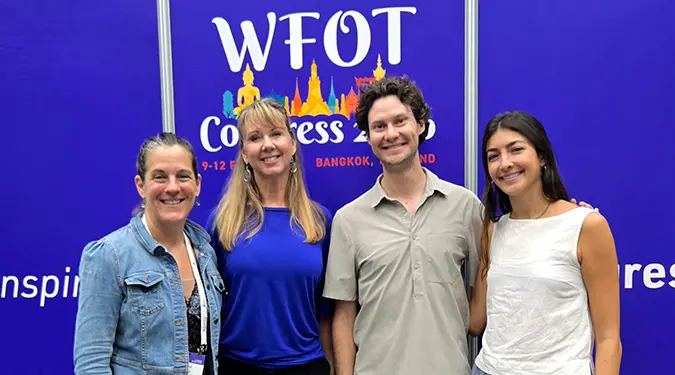
Faculty from Southern California University of Health Sciences’ Doctor of Occupational Therapy program recently represented SCU at the 19th World Federation of Occupational Therapists Congress in Bangkok, Thailand, one of the profession’s leading international gatherings for occupational therapy education, research, practice, and collaboration.
“The World Federation of OT Conference is where leaders in the occupational therapy profession come together and share their expertise and knowledge to help promote the profession and move the profession forward,” said Heather Thomas, PhD, OTR/L, DipACLM, Program Director of SCU’s Doctor of Occupational Therapy program.
SCU was represented by OTD faculty members Heather Thomas, PhD, OTR/L, DipACLM; Karen Keptner, PhD, OTR/L, Capstone Coordinator; and Brett Buford, OTD, OTR/L, MA(OT), BS, Assistant Professor. Thomas presented two poster sessions, and Keptner presented one titled, Occupational Adaptation in Action: An Innovative Assessment Approach to Student Wellbeing, and a Lightning Talk titled, Exploring Sensory Modulation in Adult Occupational Therapy Practice. Buford presented a poster session titled “Zooming around the world: Strategies to spice up your virtual or hybrid learning spaces.”
For Thomas, the value of WFOT extended beyond the presentations. The conference gave faculty a broader view of where occupational therapy is heading globally, including emerging conversations around chronic conditions, mental health, telehealth, artificial intelligence, and lifestyle medicine.
“To be able to be at a conference like this, where we see what some of the things coming down the pipeline for our profession are, so that we can better prepare our students for the future of OT, means a lot,” Thomas said. “We’re setting our students ahead of the curve by being able to bring back this information from a global level.”
Whole Health and Lifestyle Medicine
One of the strongest takeaways from the Congress, Thomas said, was the growing global emphasis on lifestyle medicine and whole-person approaches to care. That focus aligns closely with SCU’s identity as an Integrative, Whole Health University and with the OTD program’s curriculum.
“Our OTD program in particular has been utilizing Whole Health before it was a big thing at SCU,” Thomas said. “Our students learn about lifestyle medicine, which is a component of Whole Health, and that has been part of our program since we first started.”
Thomas said occupational therapy has long centered on what matters most to each person, a principle that closely mirrors Whole Health’s emphasis on person-centered care.
“This term Whole Health, and the fact that other professions are now saying, ‘What matters to you?’ is something that occupational therapists have always done,” Thomas said. “Our job is to look at what those daily things are that you do every day that are important to you and that you want to be able to do.”
SCU’s OTD program is one of the few universities in the country to offer students a partial academic pathway in lifestyle medicine, giving graduates a head start toward board certification in lifestyle medicine.
Trends Shaping the Future of OT
Among the major themes Thomas identified from the Congress were chronic condition management, the renewed importance of occupational therapy in mental health, the growing use of artificial intelligence, and the expansion of telehealth.
“Addressing chronic conditions is one of them. Mental health is the other,” Thomas said. “OTs have been working in mental health since 1917, but the importance and resurgence of the need for OTs to be working in the mental health arena, that was a takeaway.”
Artificial intelligence was another major topic. Rather than replacing occupational therapists, Thomas said AI is being explored as a tool to support practice, education, and access to information.
Telehealth also stood out, particularly in expanding access in rural communities where patients may have limited access to hospitals, clinics, or outpatient services. Thomas said this reinforced the value of SCU’s OTD curriculum, which includes a full telehealth course.
Presenting Emerging Scholarship
Dr. Thomas’ poster examined the emerging role occupational therapy may play in supporting integration practices following legally administered psilocybin-assisted therapy, with a focus on helping clients translate therapeutic insights into sustainable routines, roles, and meaningful daily participation.
The poster, titled “The Role of OT in Psilocybin Integration Using the Occupational Therapy Practice Framework,” was co-presented by Thomas and SCU OTD alumna Gal Elkayam, OTR/L. The presentation analyzed how the Occupational Therapy Practice Framework, 4th Edition, can be applied to psilocybin integration, particularly in helping individuals build routines, modify habits, improve occupational engagement, and support long-term behavior change.
A Global Perspective for SCU Students
For Thomas, one of the most valuable aspects of WFOT was learning from occupational therapists working in different countries and cultural contexts.
She cited an example from Japan, where occupational therapists helped develop a dementia-focused restaurant concept known as the Restaurant of Mistaken Orders. The initiative gives people living with dementia an opportunity to work in a restaurant environment, while customers understand that their orders may not arrive exactly as requested. Thomas said the concept promotes meaning, purpose, social inclusion, and greater public understanding of dementia.
“Hearing about what other OTs are doing in other countries helps us shift our curriculum,” Thomas said. “We’re not just educating students in this little, tiny bubble of what’s happening in Southern California. We are now educating students on a global level.”
SCU’s participation in WFOT also supports the university’s growing visibility within the occupational therapy profession and creates opportunities for future collaboration in research, capstone projects, guest lectures, and faculty partnerships.
“It’s really good for SCU’s name to be out there,” Thomas said. “As we grow, for us to be at the forefront of people’s minds as a Whole Health institution, and by other leaders in the profession seeing us there, hearing about us, seeing us present, is really important.”
Through its participation in the 19th WFOT Congress, SCU’s OTD faculty brought a global perspective back to the classroom, reinforcing the university’s commitment to Whole Health, innovation, evidence-based practice, and preparing future occupational therapists to meet the evolving needs of individuals and communities.
Related Posts