SCU Ayurveda Program Director Serves as Chair of the International Delegates Assembly at International AYUSH Conference in Dubai
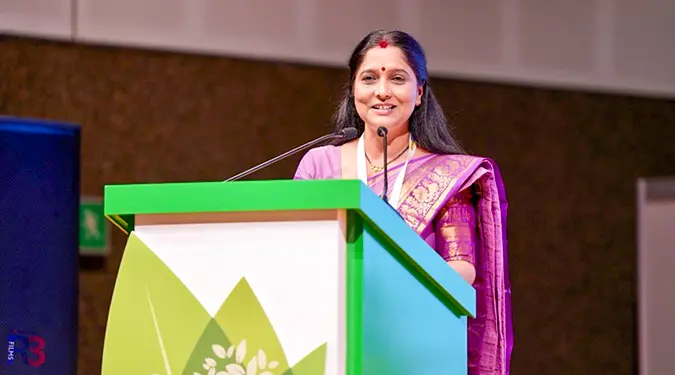
Southern California University of Health Sciences (SCU) continues to expand its global presence in integrative and Whole Health education, as Ayurveda Program Director Dr. Anupama Kizhakkeveettil took on a leadership role at the 3rd International AYUSH Conference & Expo 2026 in Dubai.
Held at the Dubai World Trade Center, the conference brought together more than 2,000 delegates from over 30 countries, including researchers, clinicians, policymakers, and industry leaders focused on advancing evidence-based traditional and integrative healthcare systems.
“Being represented at a global conference of this scale is both an honor and a responsibility,” Dr. Kizhakkeveettil said. “For SCU, it reflects our growing role as a leader in integrative and Whole Health education and signals that our work is both academically rigorous and globally relevant.”
Leading International Collaboration in Integrative Health
Dr. Kizhakkeveettil served as Chair of the International Delegates Assembly (IDA), guiding discussions among experts from more than 15 countries. The Assembly focused on moving beyond presentations to develop shared frameworks for advancing integrative healthcare globally.
“My primary goal as Chair was to create genuine dialogue—not simply a platform for presentations, but a structured space where practitioners and researchers could arrive at shared frameworks,” she said.
The Assembly included six thematic panels addressing key global health priorities, including mental well-being, lifestyle-related diseases, integrative best practices, and sustainable healthcare systems.
From Dialogue to Action: Global Initiatives Launched
A central outcome of the Assembly was the release of a draft White Paper titled “AYUSH Interventions for Mind and Body Health,” designed to address gaps in prevention, long-term care, and community-based healthcare delivery.
According to Dr. Kizhakkeveettil, the white paper emphasizes principles foundational to AYUSH systems—such as lifestyle regulation, personalization, and self-care—and translates them into an evidence-informed framework aligned with modern public health priorities.
“This work reflects a pathway for strengthening healthcare delivery in ways that are culturally grounded, scalable, and focused on prevention,” she explained.
In parallel, a Global Practitioners’ Survey was launched to collect real-world data on clinical practices, challenges, and opportunities across international settings. The goal is to use these insights to inform future policy development, education models, and clinical standards within integrative healthcare systems.
Together, these efforts represent a shift toward building a more structured, evidence-informed foundation for integrating traditional medicine into global healthcare systems.
Connecting Ayurveda and Modern Science
Dr. Kizhakkeveettil also delivered a plenary presentation on Ayurvedic Rasayana and cellular aging, exploring how traditional concepts align with modern scientific understanding of aging.
Rasayana focuses on promoting cellular vitality and longevity—principles that correspond with key biological processes such as oxidative stress, inflammation, mitochondrial decline, and telomere shortening.
When applied in clinical contexts, these approaches may support improved energy, immune function, cognitive health, and overall resilience—areas of increasing importance as healthcare systems respond to aging populations and chronic disease.
“In chronic disease management, Rasayana takes a systems-based approach, helping regulate underlying drivers such as inflammation and immune dysregulation rather than just managing symptoms,” she said.
This perspective reflects a broader shift toward preventive, patient-centered care models that emphasize long-term health outcomes and quality of life.
Faculty Scholarship Highlights Clinical Applications
SCU’s presence at the conference also included contributions from Ayurveda faculty member Jayagopal Parla, who presented on evidence-informed strategies for addressing autoimmune and metabolic disorders using classical Ayurvedic frameworks.
His work demonstrated how traditional herbal classifications described in the Charaka Samhita can be applied in modern clinical contexts, supporting personalized and integrative approaches to care.
A Growing Role in the Future of Healthcare
For Dr. Kizhakkeveettil, one of the most important takeaways from the conference is the increasing global recognition of integrative, prevention-focused care as a necessary evolution in healthcare systems.
“The discussions highlighted how traditional systems can complement modern biomedical science by addressing the root mechanisms of aging and chronic disease,” she said.
She emphasized that the future of healthcare will require approaches that extend beyond symptom management to focus on Whole Health, prevention, and long-term health outcomes.
“The future is not about replacing one model with another—it’s about intelligently integrating the best of all systems.”
Dr. Kizhakkeveettil’s work at the International AYUSH Conference highlights SCU’s commitment to advancing Whole Health education and to contributing to global conversations about more sustainable, patient-centered models of care.
Related Posts