What Is a White Coat Ceremony and Why Does It Matter in Healthcare Education?
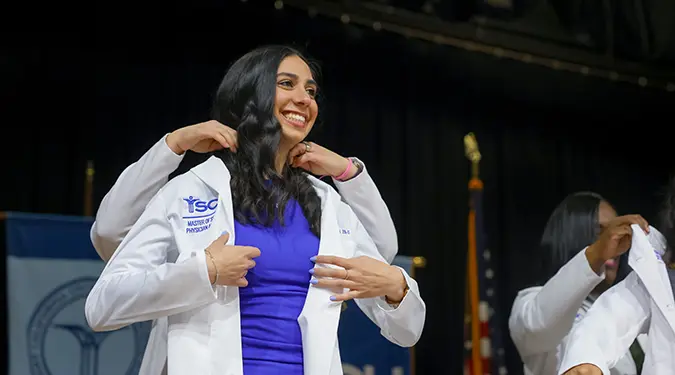
Every year, hundreds of SCU students participate in White Coat Ceremonies as they transition from classroom learning to supervised clinical training. These ceremonies are more than just tradition. They have a rich history rooted in the same whole-person approach to care that SCU embraces as an Integrative, Whole Health University.
What Is a White Coat Ceremony?
A White Coat Ceremony is a meaningful rite of passage that formally welcomes students into a healthcare profession. During the ceremony, students receive their first white coats and often recite a professional oath, publicly committing to ethical conduct, responsibility, and compassionate service.
The ceremony emphasizes that healthcare is both:
- A scientific discipline grounded in evidence and clinical skill
- A human-centered profession rooted in empathy, trust, and integrity
Today, White Coat Ceremonies are held across medical, chiropractic, physician assistant, physical therapy, and other health sciences programs throughout the United States.
What Is the History of the White Coat Ceremony?
The modern White Coat Ceremony was introduced in 1993 by the Arnold P. Gold Foundation at Columbia University. It was created in response to growing concern that medical education was becoming increasingly technical, sometimes at the expense of empathy and human connection.
From its inception, the ceremony was designed to emphasize:
- Professionalism and integrity
- Compassion and empathy
- The importance of the provider–patient relationship
Since then, it has become a widely adopted tradition in healthcare education worldwide.
Why Are Student White Coats Shorter Than Physician Coats?
One of the most visible aspects of the ceremony is the length of the white coat. Students receive short, student-style white coats, while fully licensed physicians and experienced clinicians typically wear longer coats. This distinction is intentional.
The shorter coat:
- Identifies the wearer as a student or clinician-in-training
- Promotes transparency with patients
- Reinforces humility and lifelong learning
- Reflects responsibility under supervision
Rather than symbolizing status, the short white coat represents accountability, service, and professional growth—principles that align closely with SCU’s Whole Health philosophy.
How Does the White Coat Ceremony Reflect SCU’s Whole Health Mission?
As an Integrative, Whole Health University, SCU approaches the White Coat Ceremony as a values-based induction into a profession that cares for the whole person.
Whole Health at SCU emphasizes:
- Caring for mind, body, and spirit
- Addressing prevention, lifestyle, and social determinants of health
- Integrating evidence-based and complementary approaches
- Building respectful, collaborative provider–patient relationships
The White Coat Ceremony reinforces that SCU students are being called not only to clinical excellence, but also to leadership and systems-level transformation in healthcare.
Students in programs such as the Doctor of Chiropractic program, Doctor of Physical Therapy, and Master of Science: Physician Assistant begin their academic journey grounded in ethical responsibility and whole-person care.
Why Is the White Coat Ceremony Important for Future Healthcare Leaders?
The ceremony serves as an early reminder that technical skill alone is not enough.
It encourages students to:
- Reflect on the privilege of caring for patients
- Recognize the trust placed in healthcare professionals
- Commit to professionalism from the start of their training
- Embrace service and community impact
At SCU, this tradition prepares graduates to advance Whole Health and contribute to a more equitable healthcare system.
Frequently Asked Questions About the White Coat Ceremony
Is the White Coat Ceremony the same as graduation?
No. The White Coat Ceremony marks the beginning of a healthcare student’s academic journey, while graduation marks the completion of their professional training.
Do all healthcare programs have a White Coat Ceremony?
Many medical and health sciences programs across the U.S. hold White Coat Ceremonies, including chiropractic, physician assistant, and physical therapy programs.
Why is professionalism emphasized at the start of training?
Introducing professionalism early helps students form a strong ethical foundation before they begin clinical experiences with patients.
What does the white coat symbolize?
The white coat symbolizes trust, responsibility, accountability, and a commitment to compassionate patient care.
Related Posts