Medicare Covers Acupuncture—So Why Can’t Licensed Acupuncturists Provide It?
Nearly five years after Medicare approved acupuncture as a covered, evidence-based treatment for chronic low back pain, access to care remains strikingly uneven across the United States. In many regions, older adults technically have coverage—but little practical ability to receive acupuncture from trained providers.
New research presented by faculty from Southern California University of Health Sciences (SCU) reveals just how wide these gaps are—and points to a central policy contradiction at the heart of Medicare’s acupuncture benefit.
Extreme Geographic Inequities in Access
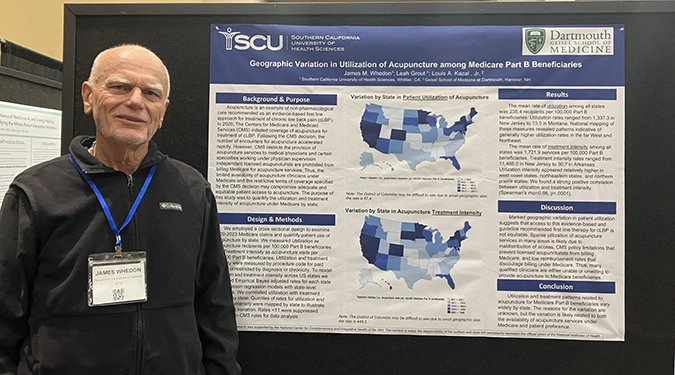
At the recent Academy of Integrative Health & Medicine (AIHM) Conference, SCU researchers presented a national analysis of Medicare acupuncture utilization that uncovered dramatic disparities from state to state.
The study, led by SCU Senior Health Services Researcher Dr. James Whedon, examined Medicare Part B claims data from 2020 through 2023 to assess how frequently beneficiaries accessed acupuncture for chronic low back pain following Medicare’s coverage decision.
Researchers analyzed two key measures across all 50 states:
- Utilization (patients per 100,000 Medicare beneficiaries)
- Treatment intensity (visits per 100,000 beneficiaries)
The findings were striking. Some states showed more than 100-fold higher utilization than others. Treatment intensity closely mirrored these patterns, with a near-perfect correlation between the two—indicating systemic differences rather than random variation.
“What surprised us most was the magnitude of the differences,” said Dr. Whedon. “There is always some geographic variation in healthcare use, but these disparities were extreme and not easily explained by population size or patient need alone.”
States along the West Coast, parts of the Northeast, and northern prairie regions demonstrated substantially higher access, while many interior and southern states showed extremely limited use of Medicare-covered acupuncture.
The Policy Contradiction at the Center
The data point to a structural issue that many licensed acupuncturists already understand firsthand: Medicare covers acupuncture, but largely excludes the professionals most qualified to provide it.
Although Medicare began covering acupuncture for chronic low back pain in 2020—recognizing it as a first-line, non-pharmacologic treatment—licensed acupuncturists are not authorized to bill Medicare directly.
“As expected, the data show that the clinicians who are most highly trained in acupuncture are not available to provide acupuncture under Medicare,” Dr. Whedon explained. “The lack of availability is a direct result of barriers to access incorporated into federal health policy.”
Currently, Medicare limits reimbursement to physicians and certain supervised practitioners. In many regions, this effectively sidelines the majority of the acupuncture workforce and leaves beneficiaries without meaningful access—particularly in rural and underserved areas.
What This Means for Licensed Acupuncturists
For licensed acupuncturists, the study confirms what many have observed anecdotally since Medicare coverage began: coverage without provider recognition does not translate into access.
In low-utilization states, older adults may have acupuncture listed as a covered benefit yet have no realistic way to receive care from trained acupuncturists. Meanwhile, licensed practitioners remain unable to serve Medicare patients despite extensive education, clinical training, and state licensure.
The result is a system that underutilizes a qualified workforce while failing to meet patient demand for safe, non-pharmacologic pain care.
A Clear Path Forward
According to the researchers, meaningful improvement will require modernization of federal policy—not changes to acupuncture itself.
“Congress should enact changes to the Social Security Act, which governs Medicare,” said Dr. Whedon. “Licensed acupuncturists should be authorized Medicare providers and allowed to bill directly for services already within their state-defined scope of practice.”
Such reforms would align Medicare policy with existing state licensure standards, expand access for beneficiaries, and allow licensed acupuncturists to fully participate in caring for older adults.
“If Medicare rules were modernized,” Dr. Whedon added, “licensed acupuncturists would become an integral part of the U.S. healthcare workforce, available to provide safe and effective care for millions of older adults.”
Research to Support Advocacy
This study is part of an ongoing, NIH-funded research initiative examining acupuncture access, utilization, and patient outcomes nationwide. Additional analyses are underway and will continue to inform discussions around policy reform.
“Policy makers and healthcare advocates need high-quality data to justify their positions,” Dr. Whedon said. “Our research provides externally valid evidence to support informed decision-making.”
For licensed acupuncturists engaged in Medicare advocacy, the findings offer clear, data-driven confirmation that provider exclusion—not lack of demand—is a major driver of unequal access.
Moving From Coverage to Care
Medicare’s decision to cover acupuncture was an important milestone. But as this research demonstrates, coverage alone is not enough.
Until licensed acupuncturists are recognized as Medicare providers, geographic inequities will persist, patients will continue to face barriers, and the promise of non-pharmacologic pain care for older adults will remain only partially fulfilled.
Related Posts