SCU President Dr. John Scaringe Delivers Commencement Message on Compassion to the Class of 2025
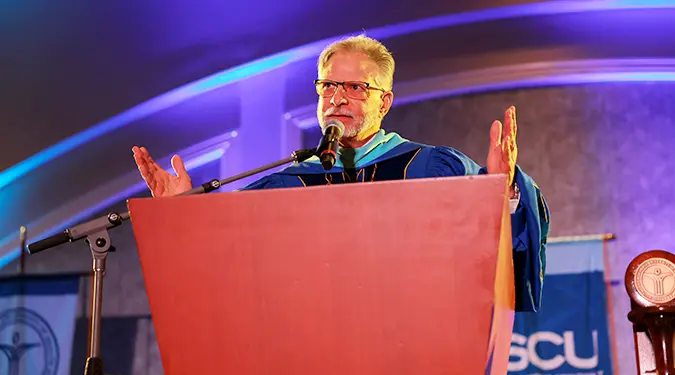
At Southern California University of Health Sciences’ 2025 Commencement Ceremony, University President Dr. John Scaringe delivered a heartfelt and deeply personal address centered on one essential principle: compassion.
Speaking to graduates poised to enter the healthcare professions, Dr. Scaringe reminded the Class of 2025 that while clinical knowledge and technical expertise are critical, it is compassion — expressed through presence, dignity, and action — that ultimately defines meaningful leadership and healing.
Through personal stories drawn from his own life, Dr. Scaringe illustrated that compassion is not simply an abstract value or “soft skill,” but a courageous, active choice to show up for others during their most vulnerable moments. His message resonated strongly with SCU’s mission to educate healthcare leaders who care for the whole person — body, mind, and spirit.
Dr. Scaringe’s Commencement Speech
Today is truly a remarkable day for you, your families, your faculty, and let’s be honest, it’s also a remarkable day for anyone who no longer has to hear, “I can’t, I have to study.” You and your loved ones have waited a long time for this moment. Commencement ceremonies often invite big themes such as success, purpose, and, in our case, the future of healthcare.
But before we discuss any of that, I want to begin somewhere a little simpler, somewhere human. Somewhere, far from the clinics, the classroom, or accreditation reports. I want to start in a high school locker room. When I was a senior in high school, at the end of a senior tournament, I wrestled my final match, and I lost.
Now, if you’ve ever been 17, you are absolutely certain that the entire universe is paying attention to your every move. You know exactly what that felt like. So, I walked into the locker room, and I sat by myself. I wasn’t angry. I wasn’t hurt. I was simply disappointed. The kind that feels enormous right at that age, because most disappointments do.
A few minutes later. My father walked in. He didn’t tell me to shake it off. He didn’t give me a pep talk. He didn’t offer a replay of the footage of what I should have done, what I didn’t do, and what I could have done. He didn’t even give me that classic dad line of, “Someday you’ll laugh at this,” because he knew I wasn’t going to be laughing anytime soon.
He sat down next to me. Quiet, present, and even though the disappointment didn’t go away, something else happened. I didn’t feel alone anymore. Years later, I realized what he offered that day. It wasn’t advice, it wasn’t encouragement. It wasn’t even problem-solving. It was compassion. The quiet kind that doesn’t just fix the moment.
He doesn’t try to fix that moment, but he chooses to be in that moment with you, and that simple act has stayed with me throughout my life. Compassion is often confused with empathy. They’re related, but they’re not exactly the same.
For example, empathy is seeing someone on the side of the road on a rainy day fixing their flat tire, and you say to yourself. Oh, that poor son of a gun, that must be awful. Compassion is stopping, getting out, and helping them fix that flat tire. Compassion is movement. In other words, empathy feels, compassion moves.
Empathy understands the moment, and compassion enters it. And in healthcare, that is all the difference. Your patients won’t just need your knowledge. They won’t just need your technical expertise. They will need your presence, your willingness to step in the moment with them. That shift from feeling to doing is where healing begins in your career.
You will meet people on some of their hardest days—people who feel vulnerable, afraid, confused, and overwhelmed. Two patients may walk in with the same diagnosis but carry entirely different stories. Compassion is what helps you treat the story as much as the symptoms. It shows up in small and often unnoticed ways when you take a moment longer to listen.
When you ask a question that nobody else has thought to ask, and when you acknowledge a fear, rather than rush past it. When you offer dignity in a time when someone feels exposed, not because the moment was any less painful, but when your presence says simply, you matter. Compassion doesn’t require perfection. It requires presence.
Presence is often the most healing thing you can offer. Whether or not you see yourself as a leader today, compassion will make you a leader. Leadership isn’t about authority. Leadership is the courage to act, to care, to advocate for someone who has no voice, to slow down when the world tells you to speed up, and to speak out when something isn’t right.
There will be days when you’re tired and rushed and stretched so thin that the easiest path is not the compassionate one. Those are the moments that define a career, not the easy decisions, the meaningful ones. Compassion is not a soft skill. It is a courage in everyday form.
A few months ago, I delivered my mother’s eulogy. It was one of the hardest moments in my life, but when I finished speaking, I did feel something unexpected: comfort, not because it was any less painful, because believe me, it wasn’t. But, because compassion had surrounded her during her final years from my brothers who were with her nearby in New York, from her caretakers, and from other loved ones. All from people who treated her with dignity.
Dignity when she needed it the most. In that moment, I understood clearly that compassion doesn’t erase pain, it doesn’t fix everything, but it does connect us when we need it the very most, and that connection can be transformational. So, as you step off the stage today into your professional lives, here is my hope for you.
Let your empathy become passion. Let your compassion become action. Let your presence be part of the healing you provide. Show up for people, not perfectly, but fully. Listen with patience, advocate with courage. Lead with your heart. Compassion isn’t something you add to healthcare. Compassion is healthcare, and when you lead with it, you will not only transform the lives of others. You will transform on your own as well.
I often think back to that moment in the locker room with my dad. He didn’t take away my disappointment. He didn’t change the outcome. He showed up. That’s compassion. Not fixing everything, not having the perfect words, just choosing to be there.
As you enter your profession, you will have countless opportunities to show up in moments, big and small, seen and unseen. Do it with courage, do it with humanity. Do it with passion.
Congratulations, graduates. Good luck and Godspeed.
Watch the full 2025 Commencement Ceremony, including President Scaringe’s address: https://www.youtube.com/live/x-j0Dvg2a_4?si=PZ0YLcKZ_greDymz&t=3760
Related Posts